Worsening hair fall is not automatically a reason to start scalp injections. By the end, you will know which patterns need urgent diagnosis, what an assessment should include, how GFC compares with established treatments, and what to ask before booking a session.
Key takeaways
- Get a scalp diagnosis before starting GFC for unexplained shedding.
- Check whether hair loss is active, patterned, sudden, or linked to illness.
- Compare GFC with PRP, minoxidil, and prescription medicines before deciding.
- Choose a Baner clinic that explains risks, alternatives, and realistic results.
When worsening hair fall needs a diagnosis before GFC
Worsening hair fall is not an automatic reason to start gfc treatment for hair fall. If shedding is unexplained, a dermatologist should examine your scalp first; correcting the cause can matter more than injections.
- Diffuse shedding that starts two to three months after illness, surgery, childbirth, major stress, rapid weight loss or a medication change suggests telogen effluvium. Removing the trigger and correcting deficiencies may restore growth.
- A widening part, receding hairline and progressively miniaturised hairs fit pattern hair loss. GFC may be an adjunct after diagnosis, not a substitute for established treatment.
- Sharply defined bald patches, especially with eyebrow loss, suggest alopecia areata and require targeted assessment.
- Hair loss around repeatedly tight braids, ponytails, extensions or other pulled areas suggests traction alopecia. Continued tension can make it permanent.
- Pustules, heavy scale, redness, itching or inflamed skin can indicate scalp infection or dandruff-related inflammation. Treat that condition before injections.
- Shiny skin, missing follicle openings, scalp pain or rapidly advancing loss raises concern for scarring alopecia. Destroyed follicles cannot reliably be restored with an injection.
Book a diagnosis before GFC if you notice sudden patchy loss, eyebrow loss, pain, pustules, heavy scale, redness, shiny skin, missing follicle openings or rapid progression. Suspected alopecia areata, infection, inflammatory disease or scarring loss needs targeted treatment first, because delaying it can permanently reduce regrowth.
What a proper suitability assessment should check
A proper suitability assessment decides whether GFC fits the cause of hair loss, not merely how much hair you see in the drain. Expect a hair loss clinic Baner to ask:
- When did shedding start, and is it sudden, fluctuating or progressively worsening?
- Is there family history of pattern baldness, or recent illness, surgery, childbirth, major stress, weight change, restrictive diet, new medication or supplement?
- Are periods irregular, or do you have acne, excess facial hair or another hormonal symptom?
The clinician should examine scalp condition and hair density, perform a hair-pull test, and use dermoscopy. This can reveal miniaturised hairs, inflammation, broken hairs, follicular openings and scarring—findings that change the diagnosis and treatment plan.
Blood tests should follow the history, not form an automatic package. A complete blood count and ferritin address possible anaemia or iron deficiency. Thyroid-stimulating hormone fits thyroid symptoms or unexplained diffuse shedding; vitamin B12, vitamin D or zinc fit dietary risk, relevant symptoms or examination findings.
Hormone tests are appropriate when menstrual or androgen-related symptoms indicate them.
A scalp biopsy can be necessary when scarring alopecia is suspected or the diagnosis remains unclear. If shedding keeps worsening, ask when reassessment replaces further injections; continuing GFC without that checkpoint can delay treatment of thyroid disease, nutritional deficiency, alopecia areata or scarring alopecia.
What Hair GFC involves and what results can realistically mean
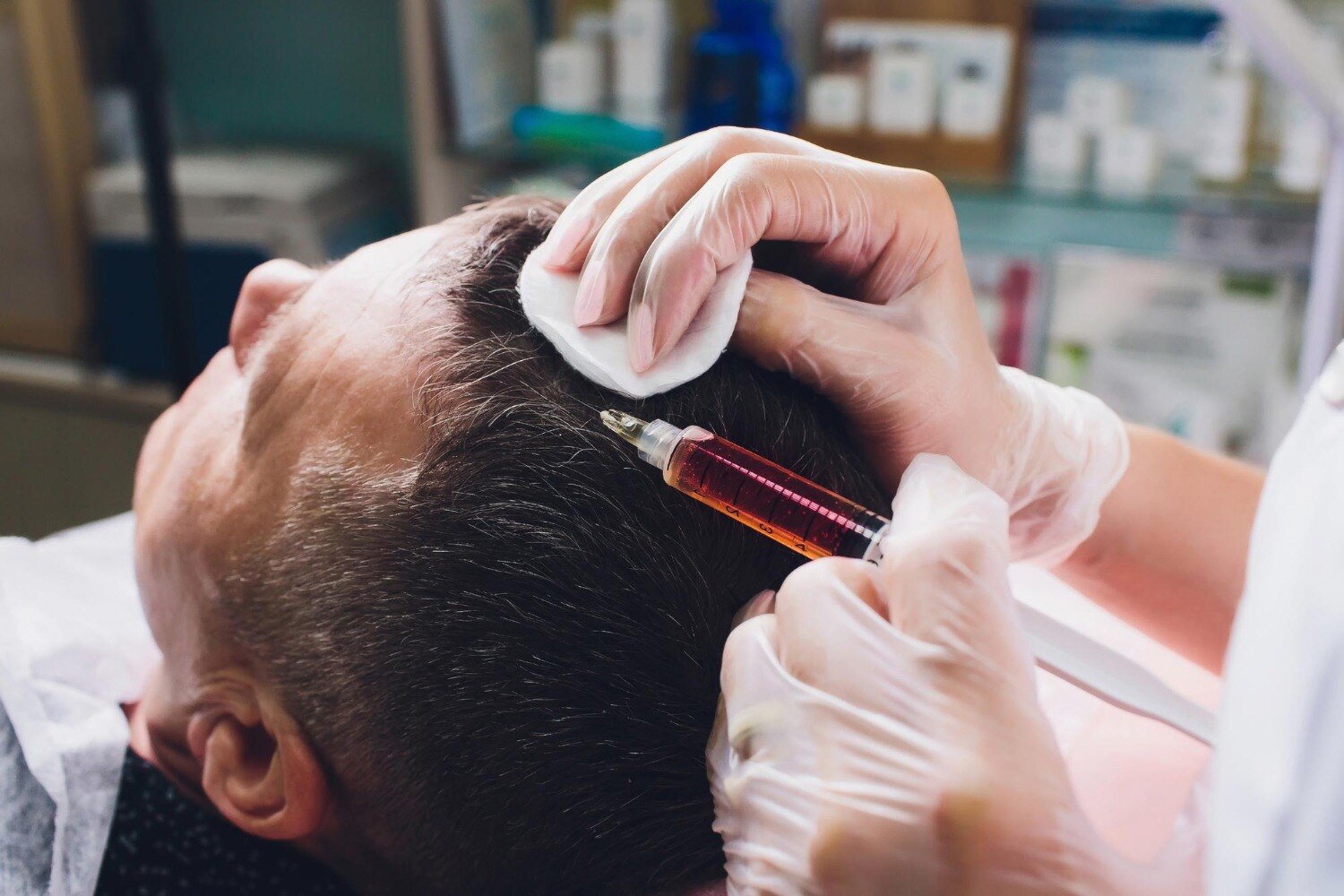
Hair GFC commonly uses your own blood: a clinician draws a sample, processes it into a growth-factor concentrate, then injects it into selected scalp areas. If you searched for hair GFC treatment baner, ask which system is used because kits are not interchangeable.
- Confirm the product or kit name, collection volume, preparation method, injection sites, proposed number of sessions and maintenance plan.
- Ask about topical or local anaesthetic. Expect brief needle discomfort, followed by tenderness, small bruises or swelling; the appointment time depends on the preparation and injection protocol.
- Get written instructions for washing your hair, sweating, exercise, hair products and medicines after treatment. Do not alter prescribed medicines without medical advice.
- Discuss anticoagulants, platelet disorders, active scalp infection and systemic illness before treatment. Infection and a fainting reaction are uncommon but possible.
GFC is an invasive procedure, not a universally standardised medicine. Evidence remains limited by small studies, different preparation protocols and short follow-up, so one kit’s result does not predict every clinic’s outcome.
Hair-cycle changes take months, not days. Compare standardised front, top and side photographs taken under the same lighting, angle and hair condition; styling and lighting can create an apparent density change. Consider GFC only after the cause of worsening loss has been assessed, because it cannot reliably restore follicles destroyed by scarring.
How GFC compares with PRP, minoxidil and prescription medicines
If pattern hair loss is suspected, GFC is not automatically the best next step. It may serve as an adjunct, but established treatments deserve comparison before you commit to injections.
GFC and PRP can both use your blood, yet they are not interchangeable. Their preparation, platelet or growth-factor content, activation method and proposed biological action differ between systems. Neither label guarantees a standardised treatment or predictable outcome.
| Option | Main trade-off | Key cautions |
|---|---|---|
| GFC | Scalp injections with a processed blood-derived concentrate; evidence is limited by differing kits and protocols | Ask for the kit name, preparation method, sessions and maintenance plan |
| PRP | Scalp injections using platelet-rich plasma; platelet concentration and activation vary | Do not assume PRP and GFC have identical biological effects or results |
| Topical minoxidil | No injections, but ongoing use is needed | Scalp irritation and an initial shedding phase can occur |
| Oral minoxidil | Prescription-only option that avoids scalp application | Review blood pressure, fluid retention, rapid heartbeat and excess hair |
| Finasteride or dutasteride | Prescription medicines for pattern hair loss | Suitability depends on sex, pregnancy potential, sexual or mood effects, reproductive plans and other health factors |
Finasteride is an established discussion for appropriate men with pattern hair loss; no option suits everyone. Oral medicines require clinician review, and you should not stop prescribed treatment without medical advice.
A search for hair regrowth treatment Baner or GFC treatment for hair fall should not bypass diagnosis. GFC cannot replace investigation of an active trigger such as illness, iron deficiency, thyroid disease or medication-related shedding.
How to choose a safe next step in Baner
Before paying for hair GFC treatment for worsening hair fall in Baner, record the start date, possible trigger, and rate of shedding. Take matching front, top and side photographs in the same light, and list every medicine and supplement.
Book diagnosis first if you have sudden patches, eyebrow loss, scalp pain, pustules, heavy scale, redness, shiny skin, missing follicle openings or rapidly advancing loss.
Use this checklist at the consultation:
- Ask whether a dermatologist examines your scalp.
- Ask when dermoscopy or blood tests are recommended.
- Ask for the exact GFC kit or preparation method, collection volume and injection plan.
- Ask which aftercare instructions and contraindications apply.
- Ask how many sessions are proposed and when progress will be reviewed.
- Ask what happens if shedding or density loss continues.
A credible plan includes baseline photographs, a defined review point and a different diagnostic pathway if density worsens. Do not accept continuing injections as the only response.
| Option | What it means | When it applies |
|---|---|---|
| GFC | An injection-based growth-factor preparation | After the likely cause is identified |
| PRP | A blood-derived preparation with different processing and contents | Compare protocol details, not labels alone |
| Medical evaluation | Examination, dermoscopy, blood tests or biopsy | Before injections when loss is unexplained or worsening |
When comparing hair regrowth treatment Baner options, use these questions with DermaBright-Skin Hair Body Specialist 08048128125 or another qualified provider. A hair loss clinic Baner should demonstrate assessment quality, not merely offer an injection.
GFC can be considered as an adjunct after the cause is identified, but worsening unexplained hair loss is a reason to investigate before proceeding.
Related service
Hair Treatments Hair GFC Treatment Specialist In Baner, Aundh, Pashan Best Hair GFC Treatment in Baner, Pune at Derma Bright – Skin Hair Laser Clinic Are you struggling with hair fall, thinning hair, or early baldness?... View service → |
Frequently asked questions
When does worsening hair fall need a diagnosis before GFC?
Seek a dermatologist’s examination first when shedding is unexplained, sudden, patchy, accompanied by scalp inflammation, or getting progressively worse. Treating the cause can matter more than injections.
What should a suitability assessment for Hair GFC check?
The assessment should review your shedding pattern, scalp condition, medical history, medicines, nutrition, recent illness or stress, and whether the follicles are likely to respond.
What does Hair GFC involve, and what results are realistic?
Hair GFC uses injections prepared from your own blood components and targeted into the scalp. Results depend on the cause and stage of hair loss; it is not a guaranteed cure or instant regrowth treatment.
How does GFC compare with PRP, minoxidil, and prescription medicines?
GFC, PRP, minoxidil, and prescription medicines differ in preparation, evidence, side effects, suitability, and maintenance. A dermatologist can match the option to your diagnosis and health history.
How can you choose a safe next step for hair loss treatment in Baner?
Choose a hair loss clinic in Baner that performs a diagnosis, explains alternatives and risks, documents the treatment plan, and sets realistic expectations before taking payment or starting injections.
Keywords